


A little premise, what is Microtonal music?
The Western piano has 12 notes per octave (aka the natural occurrence of 2 sounds having one double or half the frequency of the other). That’s it. Every key, every chord, every song you’ve ever heard or any instrument built in the Western tradition lives inside that grid. But that grid is a choice — a recent historically and culturally compromise (or decision) called 12-tone equal temperament (12-EDO), standardised broadly only in the 18th Century (no Nazis around yet).
Microtonal music is any music that uses intervals smaller than a semitone (or half step) — the gaps between those 12 notes. These aren’t wrong notes or out-of-tune playing (although we as human consider in tune what we’re used to hear).
They’re a parallel universe of pitch that most of the world has always inhabited.
“The 12-tone scale is like agreeing that there are only 12 colours. Useful as a convention. Absurd as a fact of nature.”
LIGHT exists as a continuous spectrum of infinite wavelengths and SOUND has “a lot” of frequencies (currently Planck being the upper limit - link)
Back to Music, the cent is the standard unit here: one semitone = 100 cents. Quarter-tones = 50 cents. Maybe I should calculate my fees for gigs this way, a single minor pentatonic would give me £/$10 🤔
The further you subdivide, the more you move from a grid into a continuous spectrum.
Some historical context..
A timeline of microtonal exploration
~200 BCE
Bharata’s Natya Shastra — India
The octave formally divided into 22 Shrutis, establishing the theoretical basis of Indian classical music’s microtonal system — millennia before Western equal temperament.
References:
Sparda School Of Music Blog: Introduction to Swaras in Hindustani Classical Music available here
Kalyani Akant: Measuring Frequencies of Shrutis in Indian Classical Music, published in the “2019 9th International Conference on Emerging Trends in Engineering and Technology - Signal and Information Processing (ICETET-SIP-19)”Paper available on IEEE Explore - here
YOUTUBE - 22 Shrutis Simplified - Chapte 1 & Chapter 2 by Sangeeta Shankar
~900 CE
Arabic maqam codified
Arab and Persian theorists systematise the maqam system, using 24 quarter-tones per octave. The neutral third and neutral second — notes with no Western equivalent — become defining melodic colours.
References:
Wikipedia: here
Youtube - Experiencing Maqam: An Introduction to Arabic Music, video by NYUAD (NYU Abu Dhabi) with Layth Sidiq & Andrew Eisenberg
Youtube - Maqam: The Alphabet of Arabic Music by Maya Youssef
Late 19th & 20th Century
Julian Carrillo (1875-1965) Mexico
Studied Violin and Composition in both Mexico and Europe. During a class on Acoustics (whilst in Mexico City) he became interested in exploring microtonal music.
His research lead him to discover that you could break the whole tone not only in 2 or 3 steps but more, way more, he reached 16 steps in a whole tone. He asserted that 16th tones were the limit of human perception when it came to microtones.
He went on and in the early 20th Century he began composing using these microtonal intervals, pushing this language forward.
“[…]he created a new system of music notation and had special instruments built on which his microtonal works could be performed” (from Britannica link here).
Here’s a list of his Microtonal compositions:
First a Discogs link
Symphonies:
Symphony No. 3 (1945): His first fully microtonal symphony. It explores avant-garde textures using his Sonido 13 principles rather than standard diatonic scales.
The First Columbus Symphony (1926): Formally commissioned by the legendary conductor Leopold Stokowski for the Philadelphia Orchestra. It is composed entirely in quarter-, eighth-, and sixteenth-tones.
The Second Columbus Symphony (1926): Also commissioned alongside the first by Stokowski. It further maps out macro-orchestral textures using minuscule microtonal intervals
Masses:
Misa a S.S. Juan XXIII (Mass for Pope John XXIII, 1962): His most famous a cappella vocal mass, written entirely for a male chorus using quarter-tones
Misa de la Restauración (Mass of the Restoration, 1940s): Written in quarter-tones, this was his first major foray into large-scale microtonal sacred music.
Celebrated Masterworks:
Preludio a Colón (1922): His absolute first and most famous microtonal work. It is written for soprano, flute, guitar, and cello in quarter-tones, plus a harp-sitar in sixteenth-tones.
Sonata casi fantasía (1925): A seminal solo work written in quarter-, eighth-, and sixteenth-tones.
Concertino (1926): Also commissioned by conductor Leopold Stokowski. It is arranged for a microtonal ensemble of violin, cello, guitar, octavina, horn, and harp, backed by a non-microtonal orchestra.
Concertos & Orchestral Works
Horizontes (1947): A symphonic poem featuring a microtonal triple concerto layout for violin, cello, and harp with standard orchestra.
Balbuceos (1959): A piece written explicitly for his custom 16th-tone piano and chamber orchestra.
Concerto for 1/4-tone and 1/8-tone Cello and Orchestra (1958)
Concerto No. 1 for Quarter-Tone Violin and Orchestra (1963)
Chamber & Solo Instrumental Works
Capricho for Solo Viola (1926): A technical study written in quarter-tones.
Prelude Impromptu (1929): A key microtonal solo suite piece natively composed for 24-EDO (Equal Division of the Octave) guitar. You could do this one if you wanna join Angine de Poitrine 😂
Serenata (1926): Formatted for cello and orchestra using quarter-tones.
Capricho for Piano (1959): Short, focused exploration utilizing quarter-tones.
Casi-sonatas 1–6 (c. 1960s): A collection of experimental solo pieces written for violin, viola, or cello entirely in quarter-tones.
String Quartets No. 7 & No. 8 (1964): Highly complex, late-career chamber pieces fully integrating microtonality.
1920s
Alois Hába — Czechoslovakia
Composes full operas in quarter-tone and sixth-tone systems. Establishes the first department of microtonal music at the Prague Conservatory in 1934, commissioning new instruments including a quarter-tone piano.
1930–74
Harry Partch — United States
Rejects equal temperament entirely. Works in 43-tone just intonation, building an entire orchestra of custom instruments — the Chromelodeon, the Quadrangularis Reversum, the Spoils of War — because nothing existing could play his music.
1960s–70s
Spectral music — France
Composers like Gérard Grisey and Tristan Murail build harmony directly from the overtone series, requiring orchestras to play pitches that don’t exist on a standard piano. Microtonality as acoustic physics.
Let me try explain the Overtone series. Given a frequency, let’s take 440hz and call it f😬 - the overtones will be 1/2f, 1/3f, 1/4f, 1/5f, 1/6f and 1/7f - wiki here
2017
King Gizzard & the Lizard Wizard — Australia
Flying Microtonal Banana brings quarter-tone guitar into psych-rock. A gateway drug for an entire generation of listeners previously unaware of microtonality.
2026
Angine de Poitrine — Quebec
yep, Angina Pectoris basically.
Website here - also just Google them, you’ll get a little surprise.
A masked duo from Saguenay goes viral on KEXP, playing a custom double-neck guitar with hand-carved additional frets. 13.5 million YouTube views later, microtonal music has its first mainstream breakout moment.
WORLD TRADITIONS
Microtones across cultures
Let’s go back and look at this as a geographical matter, as humans have basically looked at a way of understanding sound, to try and contain it in a framework that would then allow them to MAKE music.. This is what theory fundamentally is, it comes after the practice and build over a collective knowledge and tradition.
So a crucial distinction is that most non-Western microtonal traditions don’t arrive at microtonality starting from equal temperament. They wanted to make sense of sound and vibrations as we did and tried to understand what music is and what are the ‘frequency’ relationships that matter.
SOUTH ASIA
Indian classical — shrutis
22 shrutis per octave, unevenly spaced, rooted in just intonation ratios. Each raga assigns specific shrutis to specific notes, making the “same” note — say, the minor third — a slightly different pitch in Raga Bhairavi versus Raga Darbari.
Just intonation · 22-shruti system
MIDDLE EAST / NORTH AFRICA
Arabic maqam
24 quarter-tones per octave, but the neutral intervals — halfway between major and minor — are the point, not a compromise. The maqam Rast uses a neutral third that sounds neither major nor minor to Western ears; it sounds exactly right to everyone else.
24-EDO · neutral intervals
TURKEY / CENTRAL ASIA
Turkish makam
Traditionally uses a 53-tone system (53-EDO), derived from a stack of pure fifths. Each makam has characteristic intervals and melodic movements that simply cannot be rendered in 12-EDO without destroying what makes them identifiable.
53-EDO · Pythagorean basis
INDONESIA
Gamelan — pélog & sléndro
Gamelan orchestras use two scales — the 5-note sléndro and 7-note pélog — but crucially: each gamelan is tuned to itself. There is no universal standard. Two gamelans playing “the same” piece will produce different absolute pitches, by design.
Unique per-instrument tuning
CAUCASUS
Georgian polyphony
UNESCO-recognised three-voice choral tradition using natural, non-tempered intervals that create beating, resonant harmonics impossible in equal temperament. The dissonances are the point — they create a physical sense of vibration in the body.
Free intonation · natural harmonics
IRAN
Persian dastgah
Modal system with characteristic microtonal intervals — particularly the koron (a ever so slight flattening, roughly a quarter-tone down) and sori (slight sharpening). These aren’t ornaments: they define which dastgah you’re in.
Koron · sori inflections
Western equal temperament
12 equal semitones, each exactly 100 cents apart. Every major third is 400 cents. The “purity” of intervals is sacrificed so instruments can play in all 12 keys without retuning. A useful compromise. A compromise nonetheless.
I have a personal take on this, maybe at the end I’ll say it! 😜
Indian just intonation
Intervals derived from whole-number ratios (3:2 for the fifth, 5:4 for the major third). These are acoustically “pure” — no beating. The system doesn’t support Western-style chord changes, but Indian music doesn’t need them: it moves horizontally through time, not vertically through harmony.
Fun fact, in 1940, John Foulds (then the Director of Western Music for All India Radio) officially banned the harmonium from solo classical broadcasts as it was built with equal temperament. This ban only relaxed after 1970, was lifted in 1971 but the first Harmonium broadcast would be by Montu Banerjee on July 9th 1974.
So how does Khn De Poitrine’s guitar/bass work!?
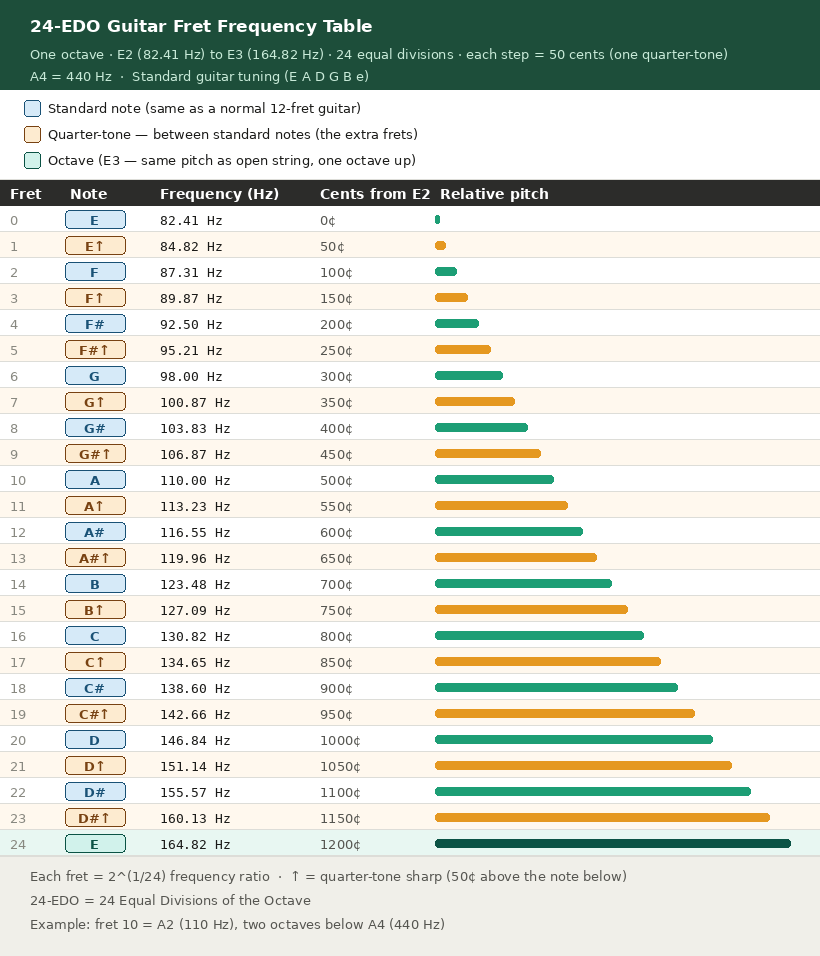
24 frets per octave: every frequency mapped
Standard Western guitars have 12 frets per octave (each fret = one semitone = 100 cents). Khn’s instrument adds a fret between each existing one, creating 24 equal divisions per octave (24-EDO). Each step is now 50 cents, a quarter-tone. The table below shows every note from the open low E string to its octave, with frequencies calculated from A4 = 440 Hz.
THE 2026 BREAKOUT
Angine de Poitrine: making microtones mainstream

Khn de Poitrine plays a double-neck instrument — part Stratocaster-style guitar, part bass — with additional microtonal frets on each neck, custom-built by a luthier in Saguenay over 150 hours. Klek plays drums.
Together, using live looping, they build songs in real time: laying a bass loop, adding microtonal guitar layers, constructing entire songs from nothing in front of the audience. Khn’s plays barefoot (assuming alien’s feet are called feet) and (what pronoun should we use?) the toework is absolutely incredible, definitely alien!
Their approach to microtonality isn’t academic. They discovered it by accident. Klek added the extra 12 frets to a guitar himself using a saw, brought it to Khn, Khn started playing it, and they both laughed at “the friction created by the proximity of the notes.” (from a Guitar Magazine interview, link here).
That friction — notes too close together for comfort, rubbing against each other — is the texture of their music. It shouldn’t work but it completely does!
Precedents exist and we’ve gone on a long journey about microtonality here, more recent examples in modern music are King Gizzard (wiki here, we mentioned the album Flying Microtonal Banana - they also recently removed all their music from Spotify and moved to BandCamp where fans can pay what they want[to a certain extent]), the late Jeff Beck explored microtonality too (Guitar Player article here), Mdou Moctar’s Tuareg guitar.
But what Angine de Poitrine have done is package microtonality inside an absurdist, visually unforgettable performance (the papier-mâché masks, the polka dots, the alien language) that makes the music feel like discovery rather than theory.
That’s the trick. That’s why 13 million people watched.
If you got this far, you might as well Subscribe - you can donate, you can join the paid tiers.