


You’ve probably seen it. That wheel. It looks like something between a clock face and a corporate logo, and most theory books introduce it with the kind of enthusiasm usually reserved for tax returns.
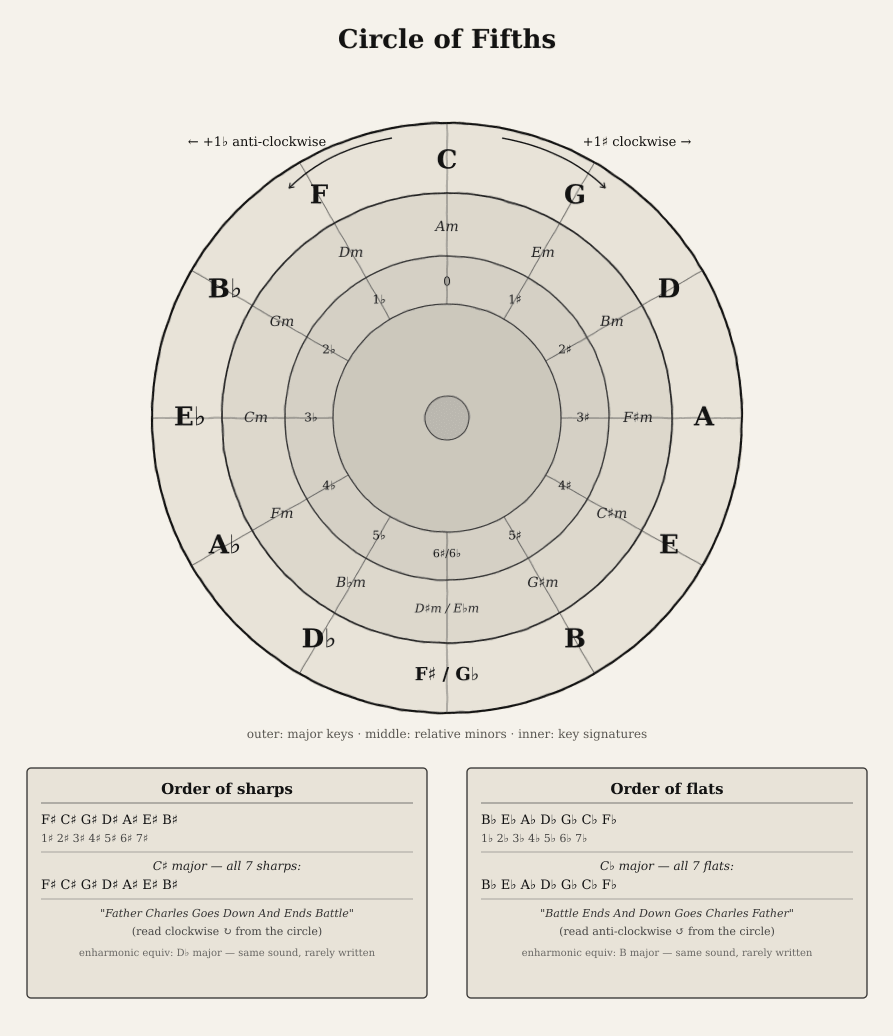
Which is a shame. Because the Circle of Fifths is genuinely one of the most elegant ideas in Western Music Theory — and once it clicks, you start seeing it everywhere. Not just in theory textbooks, but in the songs you already love.
Let me show you what it actually means.
First, Why “Fifths”?
Start on any note and go up a perfect fifth — seven semitones, the interval between the first and fifth note of a major scale. Do it again. And again. Keep going and you’ll cycle through all twelve notes before landing back where you started.
That’s it. That’s the circle.
C → G → D → A → E → B → F# → C#/Db → Ab → Eb → Bb → F → back to C.
Play those notes on a piano. Notice anything? They sound related. Not identical, but like they belong to the same extended family. That’s not an accident — it’s acoustics. A perfect fifth is the most consonant interval after the octave, and moving in fifths feels natural to the ear in a way that, say, moving in minor seconds really doesn’t.
An alternative name for it is Circle of Fourths, same principle, the fourth is another ‘perfect’ interval and it’s the reverse of a fifth, example if you flip a perfect fifth, say C→G into G→C you get a perfect fourth.
The Sharp Side: Adding One Alteration at a Time
Here’s where it gets genuinely beautiful.
Start at C major. No sharps, no flats. Clean slate. Now move clockwise around the circle — one step, one fifth up.
C major → G major
G major has one sharp: F#. Just one. Everything else is the same.
G major → D major
D major has two sharps: F# and C#. We kept the old sharp and added a new one.
D major → A major
Three sharps: F#, C#, G#. Again — kept the old ones, added one more.
See the pattern? Every step clockwise around the circle adds exactly one sharp. The key signatures build on each other, one alteration at a time, like a slow accumulation of detail.
By the time you reach F# major (six sharps) or C# major (seven sharps — every single note altered), you’re at the far side of the circle. You’ve gone as far as you can go in one direction.
The Flat Side: The Mirror Image
Now go anti-clockwise from C. One fifth down — or equivalently, one fourth up.
C major → F major
F major has one flat: Bb
F major → Bb major
Two flats: Bb and Eb
**Bb major → Eb major
Three flats: Bb, Eb, Ab
Same logic, opposite direction. Every step anti-clockwise adds exactly one flat. And if you’re paying attention, you’ll notice something else: the flats appear in the reverse order of the sharps. The first sharp is F#. The last flat (in the order they’re added) is also F — as Fb. The circle is genuinely symmetrical.
This isn’t coincidence. It’s the structure of the tuning system itself.1
Young Alberto’s trick!
A trick I used to use as a kid, when I was learning about alterations and different keys was:
memorise the order of appearance of Sharps FCGDAEB (again, fifths starting from F, aka the first sharp appearing in G, you might have to just memorise that) or memorise “Father Charles Goes Down And Ends Battle”
the number of sharps in a given key can be told by moving a whole step from the last sharp it contains. e.g. D major has 2 sharps F&C the note a step above C is, in fact D! A would contain FCG, B will contain FCGDA
memorise the order of appearance of Flats BEADGCF or memorise “Battle Ends And Down Goes Charles Father”
F contains 1 Flat, Bb, all other keys with Flats have a flat alteration on the root
The trick to find how many Flats a key has, is to go 1 flat beyond the root one, so Bb will have 2, Bb and Eb, Db will have 5 BEADG. Basically go through the list of Flats mentally and stop 1 after the ROOT!
Where Keys Live Next to Each Other
One of the most practical things the Circle of Fifths shows you is which keys are neighbours.
Keys next to each other on the circle share almost all the same notes — they differ by just one accidental. C major and G major share six out of seven notes. C major and F major, same thing.
This means modulating — moving from one key to another — feels smooth and natural when you move along the circle. One step feels like a gentle shift in light. Two steps, a little more noticeable. Five steps away and you’re in genuinely foreign territory.
Composers have always known this intuitively. The reason a song that starts in C major and visits G major briefly feels so effortless is that your ear barely notices the change — the two keys are almost the same place.
Relative Minors: The Inner Circle
You might have noticed that most Circle of Fifths diagrams have an outer ring and an inner ring. The inner ring shows the relative minor of each major key.
Every major key has a relative minor — a minor key that shares exactly the same notes, just starting from a different place. C major and A minor: identical notes, completely different emotional character.
The relative minor is always found a minor third below the major key — or if you prefer, look at the inner ring, same position on the circle.
C major / A minor
G major / E minor
D major / B minor
F major / D minor
And so on around the whole circle.
This is why switching between a major key and its relative minor is such a common move in songwriting. You’re not changing the notes at all — you’re just shifting which one feels like home. It’s one of the most powerful emotional tools in music and it costs you nothing technically.
A Practical Example: The I–IV–V
The most common chord progression in Western music — the I, IV and V — lives right there on the circle.
Take C major. The I chord is C. Look at the circle: G is one step clockwise (the V), and F is one step anti-clockwise (the IV). Your three most fundamental chords sit right next to each other on the map.
This is true in every key. The I, IV and V are always neighbours on the circle. Which means if you understand the circle, you can find your primary chords in any key instantly, without memorising each one separately.
Blues, rock, folk, country, pop — an enormous amount of music never needs to go further than these three neighbours. That’s not a limitation. That’s the point.
Moving Around the Circle in a Song
No, this is not gonna make you write songs like Bob Dylan or Jacob Collier either.
Once you understand the circle as a map, you start hearing it in music all the time.
A classic ii–V–I jazz cadence? That’s three consecutive steps on the circle moving clockwise: D minor → G → C (in the key of C). The circle is literally built into the most fundamental move in jazz harmony.
The descending bass line in a ballad that takes you from the home key through a series of chords that feel like they’re falling? Often that’s a movement around the circle — each chord pulling the one before it gently toward resolution.
And when a song suddenly feels like it’s gone somewhere unexpected — that emotional jolt of a key change — it’s often because the composer has jumped several steps at once instead of moving one at a time.
So What’s It Actually For?
The Circle of Fifths won’t write your songs for you. It won’t make you sound like anyone in particular. But it will do a few very useful things:
It tells you which keys are related and which are distant. It shows you your key signatures at a glance, without memorising twelve sets of sharps and flats separately. It reveals the family relationships between chords — why some progressions feel natural and others feel like a gear change. And it gives you a map for modulation: if you want to move to a new key, the circle shows you how far you’re going and roughly how bumpy the ride will be.
Think of it less as a rule book and more as a map of a territory you’re already walking around in. The territory exists whether or not you look at the map. But once you do, you start recognising landmarks.
One Last Thing
There’s something quietly remarkable about the fact that if you stack perfect fifths — the most natural, resonant interval in music — you eventually circle back to where you began. Twelve notes, twelve steps, one loop.
Music is full of these moments where the physics and the feeling line up perfectly. The Circle of Fifths is one of them.
Once you see it, you don’t forget it.
If this raised questions or you want to go deeper on any part of it — key signatures, modulation, relative minors — drop a comment below. And if you’ve been staring at the circle for years without it quite making sense, tell me where it lost you. That’s usually where the interesting lesson is.
I have paid articles in this Substack talking about all of this, starting from empty stave, going through the notes, the intervals, the Major and Minor scales and getting to the Circle of Fifth, so if this article didn’t make much sense to you, feel free to check those articles out, or send me a question, I’ll be glad to help.
Some great reminders in here, thanks! I’m always interested in thoughts on smooth modulations.
This is a fantastic explanation of essential information, Alberto!